Centaurus A: Difference between revisions
m 1 revision imported |
(No difference)
|
Latest revision as of 15:30, 5 February 2018
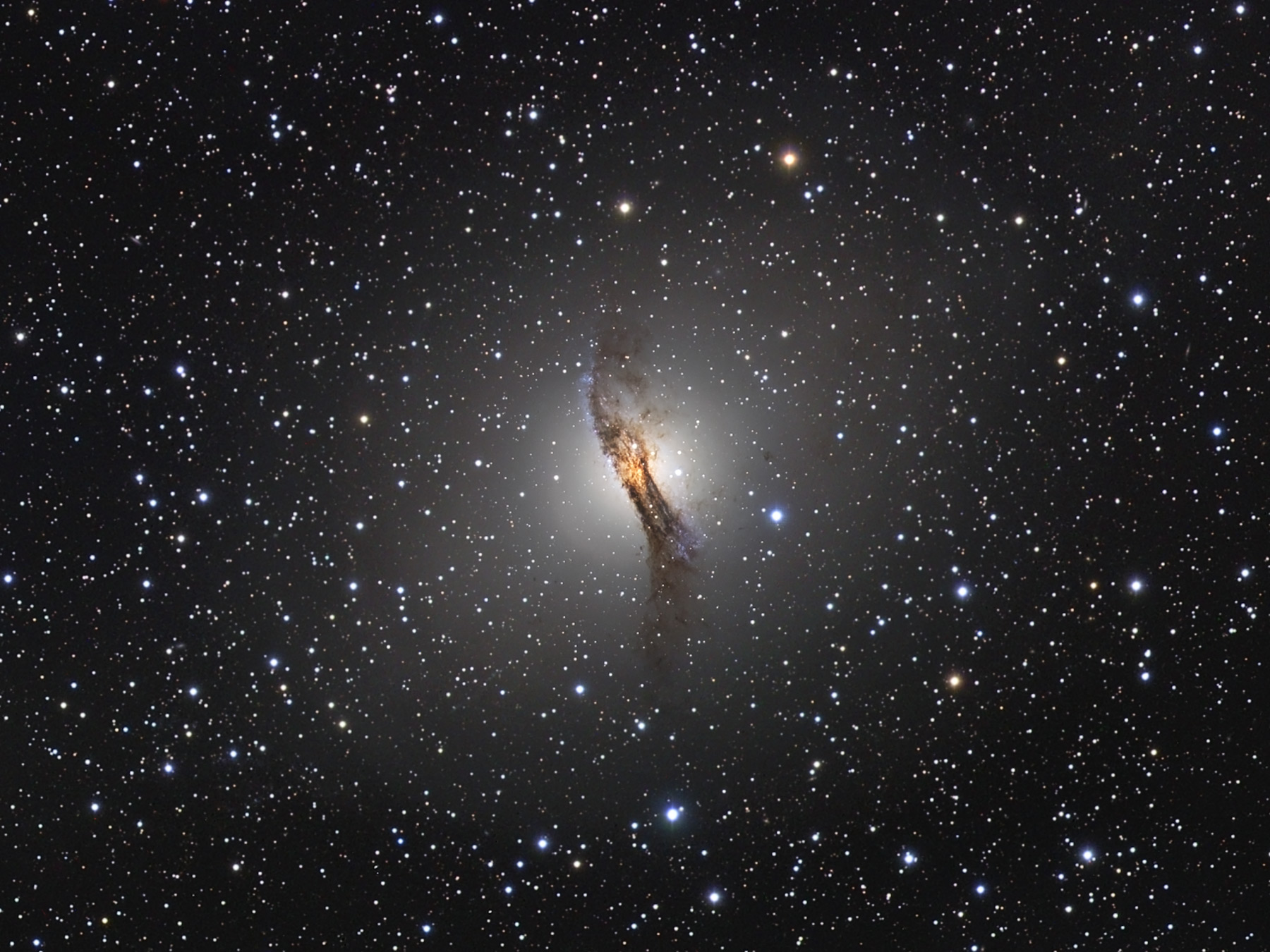
Centaurus A or NGC 5128 is a galaxy in the constellation of Centaurus. It was discovered in 1826 by Scottish astronomer James Dunlop from his home in Parramatta, in New South Wales, Australia. There is considerable debate in the literature regarding the galaxy's fundamental properties such as its Hubble type (lenticular galaxy or a giant elliptical galaxy)<ref name=harris10b/> and distance (10–16 million light-years).<ref name="tonryetal2001"/><ref name="ned-dist"/><ref name=ferrarese07/><ref name=majaess10/><ref name=harris10/> NGC 5128 is one of the closest radio galaxies to Earth, so its active galactic nucleus has been extensively studied by professional astronomers.<ref name="israel1998">F. P. Israel (1998). "Centaurus A – NGC 5128". Astronomy and Astrophysics Review. 8 (4): 237–278. arXiv:astro-ph/9811051 Freely accessible. Bibcode:1998A&ARv...8..237I. doi:10.1007/s001590050011.</ref> The galaxy is also the fifth-brightest in the sky,<ref name="israel1998"/> making it an ideal amateur astronomy target,<ref name="eicher1988">D. J. Eicher (1988). The Universe from Your Backyard. Cambridge: Cambridge University Press. ISBN 0-521-36299-7.</ref> although the galaxy is only visible from low northern latitudes and the southern hemisphere.

The center of the galaxy contains a supermassive black hole with a mass equivalent to 55 million solar masses,<ref>"Radio Telescopes Capture Best-Ever Snapshot of Black Hole Jets". NASA. Retrieved 2012-10-02.</ref> which ejects a relativistic jet that is responsible for emissions in the X-ray and radio wavelengths. By taking radio observations of the jet separated by a decade, astronomers have determined that the inner parts of the jet are moving at about half of the speed of light. X-rays are produced farther out as the jet collides with surrounding gases resulting in the creation of highly energetic particles. The X-ray jets of Centaurus A are thousands of light-years long, while the radio jets are over a million light-years long.<ref>Template:Cite APOD</ref>
Like other starburst galaxies, a collision is suspected to be responsible for the intense burst of star formation. Models have suggested that Centaurus A was a large elliptical galaxy that collided and merged with a smaller spiral galaxy.<ref name=Quillen2006>Quillen, A. C.; Brookes, M. H.; Keene, J.; Stern, D.; Lawrence, C. R.; Werner, M. W. (2006). "Spitzer Observations of the Dusty Warped Disk of Centaurus A". The Astrophysical Journal. 645 (2): 1092. arXiv:astro-ph/0601135 Freely accessible. Bibcode:2006ApJ...645.1092Q. doi:10.1086/504418.</ref>
History
NGC 5128 was discovered on 29 April 1826 by James Dunlop during a survey at the Parramatta Observatory.<ref>Peter Robertson; Glen Cozens; Wayne Orchiston; Bruce Slee; Harry Wendt (2010-01-01). "Early Australian Optical and Radio Observations of Centaurus A". Publications of the Astronomical Society of Australia. 27 (04): 402–430. arXiv:1012.5137 Freely accessible. Bibcode:2010PASA...27..402R. doi:10.1071/AS09071. ISSN 1323-3580. Retrieved 2016-08-21.</ref>
In 1847 John Herschel described the galaxy as "two semi-ovals of elliptically formed nebula appearing to be cut asunder and separated by a broad obscure band parallel to the larger axis of the nebula, in the midst of which a faint streak of light parallel to the sides of the cut appears."<ref>John Herschel (1849). "Outlines of Astronomy": 602.</ref>
In 1949 John Gatenby Bolton, Bruce Slee and Gordon Stanley localize NGC 5128 as one of the first extragalactical radio sources.<ref>J. G. Bolton; G. J. Stanley; O. B. Slee (1949). "Positions of Three Discrete Sources of Galactic Radio-Frequency Radiation". Nature. Nature. 164 (4159): 101–102. Bibcode:1949Natur.164..101B. doi:10.1038/164101b0.</ref> Five years later, Walter Baade and Rudolph Minkowski suggested that the peculiar structure is the result of a merge event of a giant elliptical galaxy and a small spiral galaxy.<ref>Baade, W.; Minkowski, R. (1 January 1954). "On the Identification of Radio Sources". The Astrophysical Journal. 119: 215. Bibcode:1954ApJ...119..215B. doi:10.1086/145813 – via NASA ADS.</ref> The first detection of X-ray emissions, using a sounding rocket, was performed in 1970.<ref>C. S. Bowyer; M. Lampton; J. Mack; F. de Mendonca (1970). "Detection of X-Ray Emission from 3C 273 and NGC 5128". Astrophysical Journal. 161: L1. Bibcode:1970ApJ...161L...1B. doi:10.1086/180559.</ref> In 1975–76 gamma-ray emissions from Centaurus A were observed through the atmospheric Cerenkov technique.<ref>Grindlay, J. E.; Helmken, H. F.; Brown, R. H.; Davis, J.; Allen, L. R. (1 April 1975). "Evidence for the detection of gamma rays from Centaurus A at gamma-ray energies above 300 GeV". The Astrophysical Journal Letters. 197: L9–L12. Bibcode:1975ApJ...197L...9G. doi:10.1086/181764 – via NASA ADS.</ref>
The Einstein Observatory detected an X-ray jet emanating from the nucleus in 1979<ref>E. J. Schreier; E. Feigelson; J. Delvaille; R. Giacconi; D. A. Schwartz (1979). "EINSTEIN Observations of The X-Ray Structure of Centaurus A: Evidence For The Radio-Lobe Energy Source". Astrophysical Journal, Part 2 – Letters to the Editor. 234: 39–43. Bibcode:1979ApJ...234L..39S. doi:10.1086/183105.</ref> Ten years later, young blue stars were found along the central dust band with the Hubble Space Telescope.<ref>"HubbleSite – NewsCenter – Hubble Provides Multiple Views of How to Feed a Black Hole (05/14/1998) – Background Info". Retrieved 2015-10-14.</ref>
The Chandra X-ray Observatory identified in 1999 more than 200 new point sources.<ref>R. P. Kraft; J. M. Kregenow; W. R. Forman; C. Jones; S. S. Murray (2001-10-20). "Chandra Observations of the X‐Ray Point Source Population in Centaurus A". The Astrophysical Journal. 560 (2): 675–688. Bibcode:2001ApJ...560..675K. doi:10.1086/323056. Retrieved 2015-10-14.</ref> Another space telescope, the Spitzer Space Telescope, found a parallelogram-shaped structure of dust in near infrared images of Centaurus A in 2006.<ref>Alice C. Quillen; Mairi H. Brookes; Jocelyn Keene; Daniel Stern; Charles R. Lawrence (2006-07-10). "Spitzer Observations of the Dusty Warped Disk of Centaurus A". The Astrophysical Journal. 645 Nummer = 2: 1092–1101. arXiv:astro-ph/0601135 Freely accessible. Bibcode:2006ApJ...645.1092Q. doi:10.1086/504418. Retrieved 2015-10-14.</ref>
Evidence of gamma emissions with very high energy (more than 100 GeV) was detcted by the H.E.S.S-Observatorium in Namibia in 2009.<ref>F. Aharonian; A. G. Akhperjanian; G. Anton; U. Barres de Almeida; A. R. Bazer-Bachi (2009-04-10). "DISCOVERY OF VERY HIGH ENERGY γ-RAY EMISSION FROM CENTAURUS A WITH H.E.S.S". The Astrophysical Journal. 695 (1): L40–L44. arXiv:0903.1582 Freely accessible. Bibcode:2009ApJ...695L..40A. doi:10.1088/0004-637x/695/1/l40. Retrieved 2015-10-14.</ref>
The following year, Centaurus A was identified as a source of cosmic rays of highest energies, after years of observations by Pierre Auger Observatory.<ref>J. Abraham; P. Abreu; M. Aglietta; C. Aguirre; D. Allard (2008-04-01). "Correlation of the highest-energy cosmic rays with the positions of nearby active galactic nuclei". Astroparticle Physics. 29 (3): 188–204. arXiv:0712.2843 Freely accessible. Bibcode:2008APh....29..188P. doi:10.1016/j.astropartphys.2008.01.002. Retrieved 2015-10-14.</ref> In 2016 a review of data from Chandra and XMM-Newton, unusual high flares of energy were found in NGC 5128 and the galaxy NGC 4636. Jimmy Erwin of University of Alabama hypothesized the discovery as potentially a black hole in a yet unknown process or an intermediate-mass black hole.<ref>"Deep space X: Mysterious flashes discovered beyond Milky Way". RT International. 2016-10-20. Retrieved 2016-10-22.</ref>
Morphology
Centaurus A may be described as having a peculiar morphology. As seen from Earth, the galaxy looks like a lenticular or elliptical galaxy with a superimposed dust lane.<ref name="carnegieatlas">A. Sandage; J. Bedke (1994). Carnegie Atlas of Galaxies. Washington, D.C.: Carnegie Institution of Washington. ISBN 0-87279-667-1.</ref> The peculiarity of this galaxy was first identified in 1847 by John Herschel, and the galaxy was included in Halton Arp's Atlas of Peculiar Galaxies (published in 1966) as one of the best examples of a "disturbed" galaxy with dust absorption.<ref name="arp1966">H. Arp (1966). "Atlas of Peculiar Galaxies". Astrophysical Journal Supplement. 14: 1–20. Bibcode:1966ApJS...14....1A. doi:10.1086/190147.</ref> The galaxy's strange morphology is generally recognized as the result of a merger between two smaller galaxies.<ref name="baademinkowski1954">W. Baade; R. Minkowski (1954). "On the Identification of Radio Sources". Astrophysical Journal. 119: 215–231. Bibcode:1954ApJ...119..215B. doi:10.1086/145813.</ref>

The bulge of this galaxy is composed mainly of evolved red stars.<ref name="carnegieatlas" /> The dusty disk, however, has been the site of more recent star formation;<ref name="israel1998"/> over 100 star formation regions have been identified in the disk.<ref name="hodgekennicutt1983">P. W. Hodge; R. C. Kennicutt Jr. (1982). "An atlas of H II regions in 125 galaxies". Astrophysical Journal. 88: 296–328. Bibcode:1983AJ.....88..296H. doi:10.1086/113318.</ref>
Supernovae
Two supernovae have been detected in Centaurus A.<ref name="nedsn">"NASA/IPAC Extragalactic Database". Results for extended name search on Centaurus A. Retrieved 2007-03-07.</ref> The first supernova, named SN 1986G, was discovered within the dark dust lane of the galaxy by R. Evans in 1986.<ref name="iauc">R. Evans; R. H. McNaught; C. Humphries (1986). "Supernova 1986G in NGC 5128". IAU Circular. 4208: 1. Bibcode:1986IAUC.4208....1E.</ref> It was later identified as a Type Ia supernova,<ref name="phillipsetal1987">M. M. Phillips; A. C. Phillips; S. R. Heathcote; V. M. Blanco; et al. (1987). "The type 1a supernova 1986G in NGC 5128 – Optical photometry and spectra". Publications of the Astronomical Society of the Pacific. 99: 592–605. Bibcode:1987PASP...99..592P. doi:10.1086/132020.</ref> which forms when a white dwarf's mass grows large enough to ignite carbon fusion in its center, touching off a runaway thermonuclear reaction, as may happen when a white dwarf in a binary star system strips gas away from the other star. SN 1986G was used to demonstrate that the spectra of type Ia supernovae are not all identical, and that type Ia supernovae may differ in the way that they change in brightness over time.<ref name="phillipsetal1987" />
The second supernova, a type IIb dubbed SN2016adj,<ref>"Supernova SN 2016adj in the peculiar galaxy NGC 5128 ("Centaurus A") - 9 Feb. 2016 - The Virtual Telescope Project 2.0". 9 February 2016.</ref> was discovered by Backyard Observatory Supernova Search in February 2016.<ref>"ATel #8651: Bright PSN in NGC5128 (Centaurus A) Discovered By Backyard Observatory Supernova Search (BOSS)". ATel.</ref>
Distance
Distance estimates to Centaurus A established since the 1980s typically range between 3–5 Mpc.<ref name="tonryetal2001"/><ref name="ned-dist"/><ref name=ferrarese07/><ref name=majaess10/><ref name=harris10/><ref name=rejkuba04/> Classical Cepheids discovered in the heavily obscured dust lane of Centaurus A yield a distance between ~3–3.5 Mpc, depending on the nature of the extinction law adopted and other considerations.<ref name=ferrarese07>Ferrarese Laura; Mould Jeremy R.; Stetson Peter B.; Tonry John L.; et al. (2007). "The Discovery of Cepheids and a Distance to NGC 5128". The Astrophysical Journal. 654: 186. arXiv:astro-ph/0605707 Freely accessible. Bibcode:2007ApJ...654..186F. doi:10.1086/506612.</ref><ref name=majaess10>Majaess, D. (2010). "The Cepheids of Centaurus A (NGC 5128) and Implications for H0". Acta Astronomica. 60: 121. arXiv:1006.2458 Freely accessible. Bibcode:2010AcA....60..121M.</ref> Mira variables<ref name=rejkuba04>Rejkuba, M. (2004). "The distance to the giant elliptical galaxy NGC 5128". Astronomy and Astrophysics. 413 (3): 903. arXiv:astro-ph/0310639 Freely accessible. Bibcode:2004A&A...413..903R. doi:10.1051/0004-6361:20034031.</ref> and Type II Cepheids<ref name=ferrarese07/><ref name=majaess10/> were also discovered in Centaurus A, the latter being rarely detected beyond the Local Group.<ref name=majaess09>Majaess, D.; Turner, D.; Lane, D. (2009). "Type II Cepheids as Extragalactic Distance Candles". Acta Astronomica. 59: 403. arXiv:0909.0181 Freely accessible. Bibcode:2009AcA....59..403M.</ref> The distance to Centaurus A established from several indicators such as Mira variables and planetary nebulae favour a more distant value of ~3.8 Mpc.<ref name=harris10b>Harris, Gretchen L. H. (2010). "NGC 5128: The Giant Beneath". Publications of the Astronomical Society of Australia. 27 (4): 475. arXiv:1004.4907 Freely accessible. Bibcode:2010PASA...27..475H. doi:10.1071/AS09063.</ref><ref name=harris10>Harris, Gretchen L. H.; Rejkuba, Marina; Harris, William E. (2010). "The Distance to NGC 5128 (Centaurus A)". Publications of the Astronomical Society of Australia. 27 (4): 457–462. arXiv:0911.3180 Freely accessible. Bibcode:2010PASA...27..457H. doi:10.1071/AS09061.</ref>
Nearby galaxies and galaxy group information
Centaurus A is at the center of one of two subgroups within the Centaurus A/M83 Group, a nearby group of galaxies.<ref name="karachentsevetal2002">I. D. Karachentsev; M. E. Sharina; A. E. Dolphin; E. K. Grebel; et al. (2002). "New distances to galaxies in the Centaurus A group". Astronomy and Astrophysics. 385 (1): 21–31. Bibcode:2002A&A...385...21K. doi:10.1051/0004-6361:20020042.</ref> Messier 83 (the Southern Pinwheel Galaxy) is at the center of the other subgroup. These two groups are sometimes identified as one group<ref name="nbg">R. B. Tully (1988). Nearby Galaxies Catalog. Cambridge: Cambridge University Press. ISBN 0-521-35299-1.</ref><ref name="fouqueetal1992">P. Fouque; E. Gourgoulhon; P. Chamaraux; G. Paturel (1992). "Groups of galaxies within 80 Mpc. II – The catalogue of groups and group members". Astronomy and Astrophysics Supplement. 93: 211–233. Bibcode:1992A&AS...93..211F.</ref> and sometimes identified as two groups.<ref name="garcia1993">A. Garcia (1993). "General study of group membership. II – Determination of nearby groups". Astronomy and Astrophysics Supplement. 100: 47–90. Bibcode:1993A&AS..100...47G.</ref> However, the galaxies around Centaurus A and the galaxies around M83 are physically close to each other, and both subgroups appear not to be moving relative to each other.<ref name="karachentsev2005">I. D. Karachentsev (2005). "The Local Group and Other Neighboring Galaxy Groups". Astronomical Journal. 129 (1): 178–188. arXiv:astro-ph/0410065 Freely accessible. Bibcode:2005AJ....129..178K. doi:10.1086/426368.</ref> The Centaurus A/M83 Group is located in the Virgo Supercluster.
Observations
Radio waves
Visibility
_and_its_strange_globular_clusters.jpg)
Centaurus A is located approximately 4° north of Omega Centauri (a globular cluster visible with the naked eye).<ref name="eicher1988"/> Because the galaxy has a high surface brightness and relatively large angular size, it is an ideal target for amateur astronomy observations. The bright central bulge and dark dust lane are visible even in finderscopes and large binoculars,<ref name="eicher1988"/> and additional structure may be seen in larger telescopes.<ref name="eicher1988"/> Centaurus A is visible to the naked eye under exceptionally good conditions.<ref>"Aintno Catalog". astronomy-mall.com.</ref>
Gallery
-
Centaurus A halo
-
The radio galaxy Centaurus A, as seen by ALMA
-
Image taken by the Wide Field Imager attached to the MPG/ESO 2.2-meter telescope at the La Silla Observatory
-
"Hubble's panchromatic vision... reveals the vibrant glow of young, blue star clusters..."<ref>"Firestorm of Star Birth in Galaxy Centaurus A". NASA. Retrieved 27 September 2012.</ref>
-
A Hubble Space Telescope (HST) image of the dust disk in front of the nucleus of Centaurus A. Credit: HST/NASA/ESA
-
This image of the central parts of Centaurus A reveals the parallelogram-shaped remains of a smaller galaxy that was absorbed about 200 to 700 million years ago.
-
The heavily obscured inner (barred?) spiral disk at 24 μm as shown by the Spitzer IR telescope
-
A composite image showing the size of the radio glow from the galaxy Centaurus A in comparison to the full Moon
-
"False-colour image of Centaurus A, showing radio (red), 24-micrometre infrared (green) and 0.5–5 keV X-ray emission (blue)
-
Central part of the galaxy
-
Video about Centaurus A jets


See also
- Messier 87 – a giant elliptical galaxy that is also a strong radio source
- NGC 1316 – a similar lenticular galaxy that is also a strong radio source
References
Sources
- STScI. Hubble Provides Multiple Views of How to Feed a Black Hole. Press release: Space Telescope Science Institute. 14 March 1998.
- Chandra X-Ray Observatory Photo Album Centaurus A Jet
External links
| File:Commons-logo.svg | Wikimedia Commons has media related to [[commons:Template:If then show|Template:If then show]]. |

- Sarka Wykes Centaurus A project
- SEDS: Peculiar Galaxy NGC 5128
- ESA/Hubble images of Centaurus A
- NASA's APOD: The Galaxy Within Centaurus A (3/4/06)
- NASA's APOD: X-Rays from an Active Galaxy (7/5/03)
- High-resolution image of Centaurus A showing the discrete elements of galactic core
- Centaurus A at UniverseToday.com
- NGC5128 Centaurus A
- NGC 5128 at DOCdb (Deep Sky Observer's Companion)
- Template:WikiSky
- Centaurus A at Constellation Guide
Template:Catalogs Template:Caldwell catalogue Template:Ngc55
- Pages with broken file links
- Pages with script errors
- Commons category link from Wikidata
- Use dmy dates from September 2017
- Articles with invalid date parameter in template
- Lenticular galaxies
- Peculiar galaxies
- Radio galaxies
- Starburst galaxies
- Centaurus A/M83 Group
- Centaurus (constellation)
- NGC objects
- Principal Galaxies Catalogue objects
- Arp objects
- Caldwell objects
- Polar-ring galaxies
- Astronomical objects discovered in 1826
- Articles containing video clips